When cross-border business becomes a dispute, UNIONE™, also part of the UNBOUNDED™ Global Ecosystem, prevents it, resolves it, arbitrates it and plans enforcement. 334 Fellows in 58 countries.
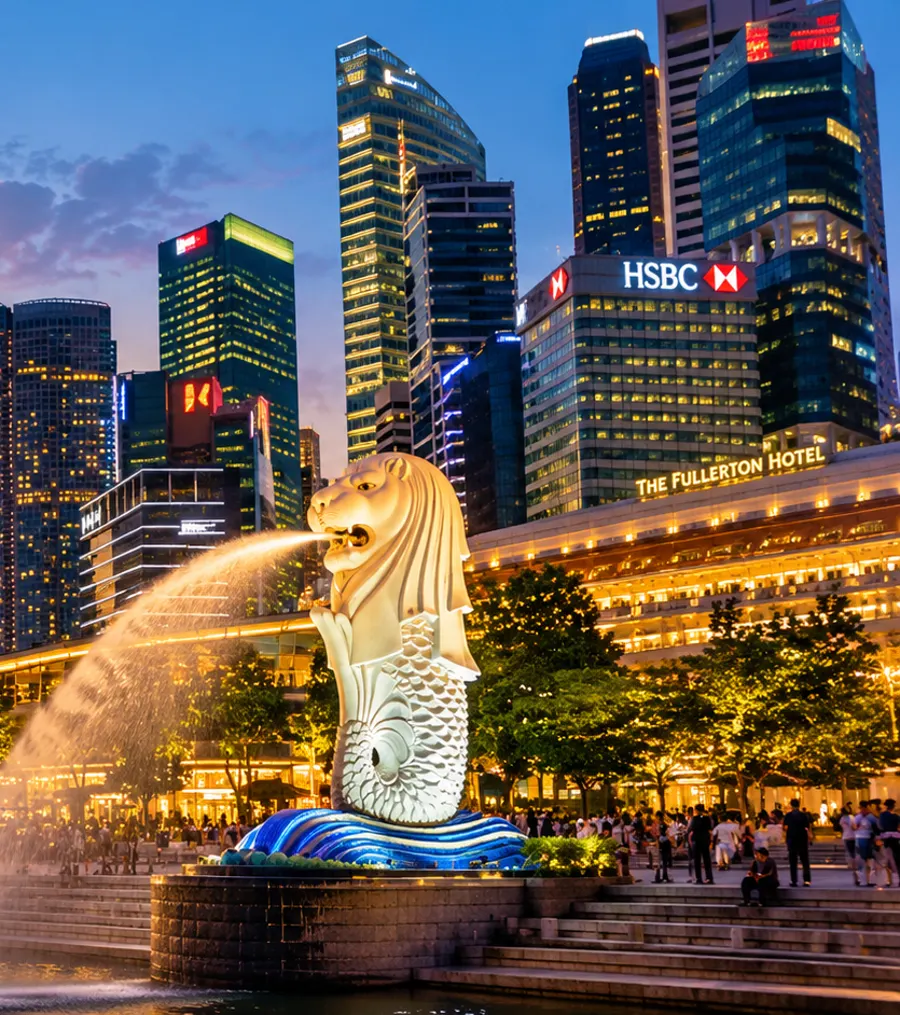
A regional headquarters, finance, technology and trading centre connecting Southeast Asia and global markets. No WONE Global Partner is in place here yet. WONE Global confirms on request whether a vetted Associate firm can act, before anything begins.
Singapore is a common-law city-state with a single national government, so company, tax and employment rules apply nationally with no state or provincial layer. Foreign businesses usually enter through a private limited subsidiary, a branch or a representative office, registered with ACRA through a corporate service provider. Corporate tax is 17% with partial exemptions, there is no withholding tax on dividends, and GST is 9%. Hiring foreign staff depends on work-pass salary thresholds and job-advertising rules, while customs duties apply only to a short list of goods.
Full guide · Source-checked research97% of statements checked against a source103 checked against an official source14 checked against a secondary sourceChecked 2026-10-19Not yet professionally reviewed
Overview
The essentials at a glance
Singapore has a common-law legal system. Companies are governed by the Companies Act 1967 and registered by the Accounting and Corporate Regulatory Authority (ACRA) through its Bizfile portal; tax is administered by the Inland Revenue Authority of Singapore (IRAS); employment and work passes by the Ministry of Manpower (MOM); and customs by Singapore Customs.
For a foreign group, the practical questions are usually who will serve as the locally resident director, how profits will be taxed and repatriated, whether foreign staff qualify for work passes, and whether the activity needs a licence from a sector regulator. Compliance obligations around beneficial ownership and nominee arrangements were tightened in 2025.
Key facts
Corporate income tax
17% (partial exemptions on first S$200,000)
GST
9% since 1 January 2024
GST registration threshold
S$1 million taxable turnover
Withholding tax on dividends
None
Minimum share capital
S$1
Local director
At least one ordinarily resident director
Employment Pass minimum salary
S$5,600 a month (plus COMPASS)
Transfer pricing documentation
Required above S$10 million gross revenue
Entry, investment and company formation
12 statements, checked against sources
Most foreign investors set up a private limited company (a subsidiary), which can be incorporated with S$1 of share capital but needs at least one locally resident director and a resident company secretary. Branches and representative offices are alternatives with different liability and tax consequences. Every foreign business must register through a corporate service provider, and beneficial ownership and nominee registers must be kept and filed with ACRA.
How it works, step by step
Engage a registered corporate service provider to act for the foreign business1ACRA (registered corporate service provider)
Reserve the company name and register the company on Bizfile, paying the registration fee2ACRA
Set up the register of registrable controllers on the day of incorporation and file it with the Central Register3ACRA
Appoint a locally resident company secretary within six months and an auditor within three months unless exempt45Company board; ACRA filings
File any later changes to officers, shareholders or nominee arrangements within the stated deadlines6ACRA
No timings or fees are shown unless an official source states them.
Documents usually needed
Proposed company name and description of business activities
Constitution (ACRA model constitution or a bespoke version)
Identity and residential address details of directors, shareholders and the company secretary
Registrable controller information for each individual or entity with significant interest or control
For a branch: certified copies of the parent's certificate of incorporation and constitution, certified English translations, and latest financial statements if required
Nominee director and nominee shareholder disclosures where applicable
Common mistakes
Assuming a foreign director can satisfy the residency requirement without a qualifying pass or Singapore residence status.
Treating the company secretary appointment as optional and leaving it beyond six months.
Using a nominee director without recording and filing the nominee arrangement.
Choosing a representative office for an activity that will generate income.
Missing the two-business-day window for filing registrable controller changes with ACRA.
Still to be confirmed · 4
Representative office eligibility criteria, validity period and fees on the Enterprise Singapore licence page could not be loaded.
The Companies Act 1967 text (including the statutory 'at least one resident director' wording and penalties) could not yet be checked.
Foreign investment restrictions in specific sectors (for example media, telecoms, financial services) were not researched in this part.
Requirements of the Corporate Service Providers Act 2024 beyond the duty to use a registered provider were not confirmed.
Accounting and Corporate Regulatory Authority (ACRA) — Appointing directors, company secretary and other key personnelChecked against an official source · checked 2026-10-18 · 3 statements
Accounting and Corporate Regulatory Authority (ACRA) — Requirements and eligibilityChecked against an official source · checked 2026-10-18 · 1 statement
Accounting and Corporate Regulatory Authority (ACRA) — Deciding on share capital and share typesChecked against an official source · checked 2026-10-18 · 1 statement
Accounting and Corporate Regulatory Authority (ACRA) — Choosing a business structureChecked against an official source · checked 2026-10-18 · 1 statement
Accounting and Corporate Regulatory Authority (ACRA) — Ways to set up in SingaporeChecked against an official source · checked 2026-10-18 · 3 statements
Accounting and Corporate Regulatory Authority (ACRA) — Registering a foreign company branchChecked against an official source · checked 2026-10-18 · 1 statement
Accounting and Corporate Regulatory Authority (ACRA) — Setting up and maintaining the Register of Registrable ControllersChecked against an official source · checked 2026-10-18 · 1 statement
Accounting and Corporate Regulatory Authority (ACRA) — Maintaining a local company's information and registersChecked against an official source · checked 2026-10-18 · 1 statement
Questions on this topic
12 statements on entry, investment and company formation in Singapore
Tax, accounting and statutory reporting
16 statements, checked against sources
Companies pay corporate income tax at 17%, reduced in practice by partial or start-up exemptions and, for year of assessment 2026, a 50% rebate. Dividends carry no withholding tax, while interest, royalties and some service fees paid abroad do. GST is 9% with registration at S$1 million of taxable turnover, and large groups are within Singapore's Pillar Two top-up taxes from 2025.
How it works, step by step
File Estimated Chargeable Income within three months of financial year end7IRAS
Monitor taxable turnover and register for GST once the S$1 million threshold is crossed or expected8IRAS
Prepare transfer pricing documentation by the filing due date where revenue exceeds S$10 million9Company; IRAS on request
File the annual corporate income tax return by 30 November10IRAS
No timings or fees are shown unless an official source states them.
Documents usually needed
Audited or unaudited financial statements (depending on audit exemption)
Tax computation supporting the Form C-S or Form C return
Transfer pricing documentation where required
Withholding tax filings and certificates of residence for treaty claims
GST registration records and GST returns
Common mistakes
Assuming services from an overseas group company are free of withholding tax when the work is performed in Singapore.
Missing the 15th-of-the-second-month deadline for withholding tax on intra-group interest or royalties.
Using the start-up exemption for an investment holding company, which is excluded.
Leaving transfer pricing documentation until an IRAS query instead of preparing it by the filing date.
Treating audit exemption as automatic without testing the small-group criteria for foreign-owned subsidiaries.
Still to be confirmed · 5
Most IRAS web pages render their body text dynamically and could not yet be checked automatically; partial exemption, start-up exemption, withholding rates, overseas vendor registration and the 30 November deadline rely on secondary sources.
Singapore's Pillar Two rules were confirmed only from a secondary source; the Multinational Enterprise (Minimum Tax) Act 2024 and IRAS guidance could not yet be checked.
The number of comprehensive tax treaties and individual treaty rates were not confirmed.
Accounting standards (SFRS and SFRS(I)) and XBRL financial statement filing with ACRA were not confirmed in this part.
Conditions for foreign-sourced income exemptions and ECI filing waivers were not confirmed.
Inland Revenue Authority of Singapore (IRAS) — Corporate Income Tax (CIT) Rate, Rebates and Tax Exemption SchemesChecked against an official source · checked 2026-10-18 · 1 statement
PwC Worldwide Tax Summaries — Singapore - Corporate - Taxes on corporate incomeChecked against a secondary source · checked 2026-10-18 · 4 statements
Allen & Gledhill — Enhancements to the corporate income tax rebate and cash grant for YA 2026Checked against a secondary source · checked 2026-10-18 · 1 statement
Inland Revenue Authority of Singapore (IRAS) — Withholding Tax filing and payment due dateChecked against an official source · checked 2026-10-18 · 1 statement
Inland Revenue Authority of Singapore (IRAS) — GST: General Guide for Businesses (Seventeenth Edition, published 30 January 2026)Checked against an official source · checked 2026-10-18 · 1 statement
Inland Revenue Authority of Singapore (IRAS) — Do you need to register for GST? (companies)Checked against an official source · checked 2026-10-18 · 1 statement
PwC Worldwide Tax Summaries — Singapore - Corporate - Other taxesChecked against a secondary source · checked 2026-10-18 · 1 statement
Inland Revenue Authority of Singapore (IRAS) — IRAS e-Tax Guide: Transfer Pricing Guidelines (Ninth Edition, published 4 June 2026)Checked against an official source · checked 2026-10-18 · 1 statement
Inland Revenue Authority of Singapore (IRAS) — Estimated Chargeable Income (ECI) filingChecked against an official source · checked 2026-10-18 · 1 statement
Accounting and Corporate Regulatory Authority (ACRA) — Audit exemptionsChecked against an official source · checked 2026-10-18 · 1 statement
Questions on this topic
16 statements on tax, accounting and statutory reporting in Singapore
Employment, payroll and mobility
13 statements, checked against sources
The Employment Act covers local and foreign employees, but the rules on hours and overtime apply only to lower-paid staff. Employers pay CPF contributions for citizens and permanent residents and Skills Development Levy for everyone. Foreign hires need a work pass with salary floors and, for Employment Pass and S Pass, a prior job advertisement in Singapore.
How it works, step by step
Advertise the role on MyCareersFuture for at least 14 consecutive days unless exempt11MOM (Fair Consideration Framework)
Check the candidate's salary against the pass threshold and COMPASS before applying1213MOM
Issue written key employment terms and register for CPF and Skills Development Levy payments1415MOM; CPF Board
No timings or fees are shown unless an official source states them.
Documents usually needed
Written contract and key employment terms
Job advertisement record from MyCareersFuture
Work pass application and supporting qualifications
Monthly CPF and Skills Development Levy submissions
Itemised payslips and employment records
Common mistakes
Assuming managers are outside the Employment Act entirely; only the hours and overtime part excludes them.
Making a job offer to a foreign candidate during the 14-day advertising period.
Using the general Employment Pass salary floor for older candidates or financial services roles, where higher figures apply.
Forgetting Skills Development Levy for foreign employees.
Not planning for the 1 January 2027 CPF changes for senior employees in payroll budgets.
Still to be confirmed · 5
Higher Employment Pass and S Pass salary thresholds for older candidates and financial services, COMPASS scoring and S Pass levy amounts were not confirmed.
The annual leave scale beyond eligibility, sick leave and parental leave entitlements were not confirmed.
The CPF rate changes from 1 January 2027 were announced but the new rates were not confirmed.
The Workplace Fairness Act 2025 and its commencement date were not researched.
Job advertising exemptions and the deadline for issuing key employment terms were not confirmed.
Ministry of Manpower (MOM) — Who is covered by the Employment ActChecked against an official source · checked 2026-10-18 · 1 statement
Ministry of Manpower (MOM) — Hours of work, overtime and rest daysChecked against an official source · checked 2026-10-18 · 2 statements
Ministry of Manpower (MOM) — Annual leaveChecked against an official source · checked 2026-10-18 · 1 statement
Ministry of Manpower (MOM) — Termination with noticeChecked against an official source · checked 2026-10-18 · 1 statement
Central Provident Fund Board (CPF Board) — How much CPF contributions to payChecked against an official source · checked 2026-10-18 · 1 statement
Central Provident Fund Board (CPF Board) — What is the Ordinary Wage (OW) ceiling?Checked against an official source · checked 2026-10-18 · 1 statement
Central Provident Fund Board (CPF Board) — Skills Development LevyChecked against an official source · checked 2026-10-18 · 1 statement
Ministry of Manpower (MOM) — Employment PassChecked against an official source · checked 2026-10-18 · 1 statement
Ministry of Manpower (MOM) — S PassChecked against an official source · checked 2026-10-18 · 1 statement
Ministry of Manpower (MOM) — Fair Consideration FrameworkChecked against an official source · checked 2026-10-18 · 1 statement
Ministry of Manpower (MOM) — RetirementChecked against an official source · checked 2026-10-18 · 1 statement
Ministry of Manpower (MOM) — Foreign worker levyChecked against an official source · checked 2026-10-18 · 1 statement
Questions on this topic
13 statements on employment, payroll and mobility in Singapore
Licensing, incentives and property
12 statements, checked against sources
Singapore licenses regulated activities through sector regulators rather than through a general foreign investment approval, so ACRA registration does not by itself permit a regulated business: banking needs MAS licensing or authorisation, and payment services need a Payment Services Act licence. Foreigners can buy condominium units and commercial and industrial property without approval but need approval for landed homes, and property purchases carry buyer's stamp duty. Government procurement runs through GeBIZ and is open by default, and EDB offers investment incentives awarded case by case.
Documents usually needed
Sector licence applications where the activity is regulated, such as a Payment Services Act licence or MAS banking authorisation
Customs licence for warehousing schemes where dutiable goods are held
Land Dealings Approval Unit application where a foreign person buys landed residential property
Property purchase or lease documentation and stamp duty returns
Incentive application and supporting investment plan for EDB
Common mistakes
Assuming ACRA registration is enough to start a regulated activity such as payments or banking.
Assuming a locally incorporated subsidiary is not a foreign person under the Residential Property Act without checking the statutory definitions.
Overlooking additional buyer's stamp duty when acquiring residential property through a company.
Treating a representative office as able to sign contracts and invoice customers.
Relying on an incentive without modelling its interaction with Pillar Two top-up taxes.
Still to be confirmed · 6
Additional buyer's stamp duty rates and current buyer's stamp duty bands were not confirmed on IRAS pages, which did not render for automated access; the buyer's stamp duty and property tax figures rest on a secondary source.
The Residential Property Act definition of a Singapore company, and when a locally incorporated company with foreign shareholders or directors is a foreign person, was not confirmed.
Capital markets, insurance and other MAS licensing regimes (Securities and Futures Act, Financial Services and Markets Act, Insurance Act) were not covered.
GeBIZ supplier registration requirements and any rules specific to foreign suppliers were not confirmed.
Incentive eligibility criteria and concessionary tax rates were not confirmed.
GoBusiness licence directory entries could not be loaded.
Singapore Customs — Permits and LicencesChecked against an official source · checked 2026-10-18 · 1 statement
PwC Worldwide Tax Summaries — Singapore - Corporate - Other taxesChecked against a secondary source · checked 2026-10-18 · 2 statements
Accounting and Corporate Regulatory Authority (ACRA) — Registering a foreign company branchChecked against an official source · checked 2026-10-18 · 1 statement
Attorney-General's Chambers, Singapore Statutes Online — Payment Services Act 2019Checked against an official source · checked 2026-10-19 · 1 statement
Monetary Authority of Singapore (MAS) — BankingChecked against an official source · checked 2026-10-19 · 1 statement
Monetary Authority of Singapore (MAS) — Licensing and Authorisation for Banking BusinessChecked against an official source · checked 2026-10-19 · 1 statement
Singapore Land Authority (SLA) — Foreign ownership of propertyChecked against an official source · checked 2026-10-19 · 2 statements
Ministry of Finance (MOF) — Government ProcurementChecked against an official source · checked 2026-10-19 · 1 statement
Ministry of Finance (MOF) — Procurement ProcessesChecked against an official source · checked 2026-10-19 · 1 statement
Economic Development Board (EDB) — Incentives and schemesChecked against an official source · checked 2026-10-19 · 1 statement
Questions on this topic
12 statements on licensing, incentives and property in Singapore
Banking, payments and repatriation
5 statements, checked against sources
Profits can be paid to foreign shareholders as dividends without Singapore withholding tax, while interest and royalties paid abroad attract withholding. Before opening an account, banks must carry out customer due diligence under MAS Notice 626: they identify and verify the company, the people acting for it and its beneficial owners, and must decline the relationship if those checks cannot be completed. Whether Singapore imposes any exchange controls was not confirmed on an official page.
How it works, step by step
Identify the company and verify its identity, legal form, constitution and powers16The bank, under MAS Notice 626
Identify the directors, connected parties and each person authorised to act for the company16The bank, under MAS Notice 626
Identify beneficial owners and take reasonable measures to verify them, cross-checking ACRA records163The bank, under MAS Notice 626; ACRA filings
Record the purpose and intended nature of the relationship and apply enhanced checks, with senior management approval, for politically exposed persons1617The bank, under MAS Notice 626
No timings or fees are shown unless an official source states them.
Documents usually needed
ACRA business profile and constitution
Register of registrable controllers and ownership chart up to the ultimate beneficial owners
Identity documents for directors, authorised signatories and beneficial owners
Board resolution authorising account opening and signatories
Explanation of the purpose of the account and expected transaction flows
Common mistakes
Opening an account before registrable controller information has been filed with ACRA.
Providing an ownership chart that stops short of the individuals who ultimately own or control the company.
Paying interest or royalties abroad without accounting for withholding tax.
Assuming treaty rates apply automatically without residence evidence.
Still to be confirmed · 4
Whether Singapore imposes exchange controls was not confirmed on an official source; no MAS, EDB or other official page opened in October 2026 addressed it, and the MAS Notice 757 page could not be loaded.
MAS rules on lending Singapore dollars to non-resident financial institutions (MAS Notice 757) were not confirmed.
The categories of politically exposed persons and the risk-based simplified and enhanced due diligence options in MAS Notice 626 were not detailed.
Bank account opening requirements beyond the MAS minimum vary by bank and were not researched.
Accounting and Corporate Regulatory Authority (ACRA) — Appointing directors, company secretary and other key personnelChecked against an official source · checked 2026-10-18 · 1 statement
Economic Development Board (EDB) — Why SingaporeChecked against an official source · checked 2026-10-19 · 1 statement
Monetary Authority of Singapore (MAS) — MAS Notice 626 Prevention of Money Laundering and Countering the Financing of Terrorism – Banks: amendment notes (June 2025)Checked against an official source · checked 2026-10-19 · 3 statements
Questions on this topic
5 statements on banking, payments and repatriation in Singapore
Customs, tariffs and trade controls
4 statements, checked against sources
Singapore is essentially a free port: customs and excise duties apply only to certain liquors, tobacco, motor vehicles and petroleum products. GST at 9% applies to imports, with relief through licensed warehousing schemes. Imports and exports need permits through Singapore Customs, and controlled and strategic goods are subject to trade controls.
How it works, step by step
Register with Singapore Customs and authorise any declaring agent18Singapore Customs
Obtain the correct import or export permit and classify the goods18Singapore Customs
Check whether the goods are controlled or strategic and need further permits19Singapore Customs and competent authorities
No timings or fees are shown unless an official source states them.
Documents usually needed
Commercial invoice and packing list
Customs permit
Bill of lading or air waybill
Certificates or licences from competent authorities for controlled goods
Certificate of origin when claiming preferential treatment abroad
Common mistakes
Assuming duty-free status means no GST on imports.
Not checking whether goods are controlled or strategic before export or transhipment.
Shipping dutiable goods without using a licensed warehousing scheme when re-export is planned.
Still to be confirmed · 4
Singapore Customs pages on duties, getting started and trade controls could not yet be checked because of rate limiting; duty scope relies on a secondary source.
The number and list of Singapore's free trade agreements (including ASEAN, RCEP and CPTPP) were not confirmed.
The Strategic Goods (Control) Act permit regime was not confirmed.
Product conformity schemes (for example Enterprise Singapore's controlled goods safety registration) were not confirmed.
PwC Worldwide Tax Summaries — Singapore - Corporate - Other taxesChecked against a secondary source · checked 2026-10-18 · 2 statements
Singapore Customs — Doing BusinessChecked against an official source · checked 2026-10-18 · 1 statement
Singapore Customs — Permits and LicencesChecked against an official source · checked 2026-10-18 · 1 statement
Questions on this topic
4 statements on customs, tariffs and trade controls in Singapore
Data protection, cybersecurity and digital compliance
11 statements, checked against sources
Singapore regulates private-sector handling of personal data through the Personal Data Protection Act 2012 (PDPA), enforced by the Personal Data Protection Commission. Every organisation in scope needs a Data Protection Officer, must control overseas transfers, and must report serious data breaches within a short statutory window. Cybersecurity rules under the Cybersecurity Act bite mainly on critical infrastructure and, since the 2024 amendments, on cloud and data-centre providers. There is no general data localisation requirement in the PDPA, but transfers abroad must meet prescribed safeguards.
Documents usually needed
Data protection policy and published Data Protection Officer contact details
Data inventory and data-flow map showing transfers outside Singapore
Intra-group data transfer agreement and vendor data processing terms
Data breach response plan with notifiability assessment record
Do Not Call Registry checking procedure for marketing teams
Common mistakes
Assuming a group privacy policy written for the EU GDPR automatically satisfies the PDPA's specific consent, DPO and breach notification rules.
Starting the 3-day notification clock late because no one has been assigned to assess whether a breach is notifiable.
Transferring HR or customer data to overseas group systems without a transfer agreement or other prescribed safeguard.
Sending SMS or call campaigns to Singapore numbers without checking the Do Not Call Registry.
Ignoring cybersecurity clauses flowed down by regulated customers such as banks, utilities or telecoms operators.
Still to be confirmed · 5
The statutory text of the PDPA and the Personal Data Protection Regulations 2021 (transfer mechanisms) could not be loaded from Singapore Statutes Online; the 3-day deadline and penalty cap rely on a secondary source.
The commencement date of the higher financial penalty cap (10% of Singapore turnover) was not confirmed on an official page.
Commencement dates of the parts of the Cybersecurity (Amendment) Act 2024 and incident reporting timelines were not confirmed.
IRAS InvoiceNow phase-in dates and scope could not yet be checked from the IRAS page.
Sector-specific technology risk and outsourcing rules (for example MAS rules for financial institutions) were not researched.
Personal Data Protection Commission (PDPC) — Personal Data Protection ActChecked against an official source · checked 2026-10-18 · 2 statements
Personal Data Protection Commission (PDPC) — Data Protection ObligationsChecked against an official source · checked 2026-10-18 · 3 statements
Attorney-General's Chambers, Singapore Statutes Online — Personal Data Protection (Notification of Data Breaches) Regulations 2021Checked against an official source · checked 2026-10-18 · 1 statement
Norton Rose Fulbright (Data Protection Report) — Amendments to the Personal Data Protection Act in forceChecked against a secondary source · checked 2026-10-18 · 2 statements
Cyber Security Agency of Singapore (CSA) — Cybersecurity ActChecked against an official source · checked 2026-10-18 · 2 statements
Inland Revenue Authority of Singapore (IRAS) — GST InvoiceNow RequirementChecked against an official source · checked 2026-10-18 · 1 statement
Questions on this topic
11 statements on data protection, cybersecurity and digital compliance in Singapore, 2 not yet checked against a source
Intellectual property and brand protection
14 statements, checked against sources
Trade marks, patents and registered designs in Singapore are registered with the Intellectual Property Office of Singapore (IPOS); copyright arises automatically under the Copyright Act 2021. Singapore belongs to the main international filing systems, including the Madrid Protocol, the PCT and the Hague Agreement, so foreign owners can extend existing filings. Registration is territorial, and early filing in Singapore is the main protection against local squatting.
How it works, step by step
Search the register for similar marks and classify goods and services under the Nice Classification20IPOS Digital Hub
File the application (or designate Singapore in a Madrid international registration), claiming any 6-month priority2122IPOS / WIPO
Respond to any examination objections within 4 months20IPOS
Publication in the Trade Marks Journal and 2-month opposition period20IPOS
Registration, then diarise renewal from 6 months before the 10-year expiry23IPOS
No timings or fees are shown unless an official source states them.
Documents usually needed
Trade mark specification of goods and services by Nice class
Priority document details for any foreign first filing
Patent specification and claims, or provisional application
Written IP assignment clauses for contractors and commissioned works
Evidence of trade mark use in Singapore
Common mistakes
Launching a brand in Singapore before filing, leaving room for third-party applications.
Assuming commissioned agency or software work belongs to the commissioning company without a written assignment.
Filing a patent abroad first from a Singapore research team without obtaining national security clearance.
Letting a registered mark go unused in Singapore for 5 years and exposing it to revocation.
Missing the 6-month renewal and restoration windows, for which IPOS allows no extensions.
Still to be confirmed · 4
Registered design term and procedure were not researched.
Border enforcement through Singapore Customs and criminal enforcement routes for counterfeits were not confirmed on official pages.
Recordal requirements for licences and assignments were not confirmed; the IPOS page reviewed does not describe them.
The statement that copyright has no registration system is based on IPOS pages that do not describe one, not on an express statement.
Intellectual Property Office of Singapore (IPOS) — Managing Trade Marks OverviewChecked against an official source · checked 2026-10-18 · 1 statement
Intellectual Property Office of Singapore (IPOS) — Introduction to Trade MarksChecked against an official source · checked 2026-10-18 · 2 statements
Intellectual Property Office of Singapore (IPOS) — How to Register Trade MarksChecked against an official source · checked 2026-10-18 · 2 statements
Intellectual Property Office of Singapore (IPOS) — Introduction to PatentsChecked against an official source · checked 2026-10-18 · 1 statement
Intellectual Property Office of Singapore (IPOS) — How to Register PatentsChecked against an official source · checked 2026-10-18 · 2 statements
Intellectual Property Office of Singapore (IPOS) — PCT RouteChecked against an official source · checked 2026-10-18 · 1 statement
Intellectual Property Office of Singapore (IPOS) — Copyright Act 2021 factsheetChecked against an official source · checked 2026-10-18 · 3 statements
World Intellectual Property Organization (WIPO) — WIPO Lex: Singapore member profileChecked against an official source · checked 2026-10-18 · 1 statement
Intellectual Property Office of Singapore (IPOS) — Resolve IP DisputesChecked against an official source · checked 2026-10-18 · 1 statement
Questions on this topic
14 statements on intellectual property and brand protection in Singapore
M&A, competition, investment screening and insolvency
13 statements, checked against sources
Singapore has no general foreign-investment approval for acquisitions, but stakes in entities designated under the Significant Investments Review Act 2024 need notification or prior approval, and regulated sectors have their own change-of-control rules. Merger control under the Competition Act 2004 is voluntary: CCS expects parties to self-assess against indicative market-share and small-merger thresholds and to notify where a deal may substantially lessen competition. Insolvency and restructuring sit in one statute that adopts the UNCITRAL Model Law on Cross-Border Insolvency. The Take-over Code points remain unconfirmed.
Documents usually needed
Market definition and market share analysis for the competition self-assessment
Singapore and worldwide turnover figures for each party for the preceding financial year
Check of the OSIR designated entities list for the target and its group
List of sector licences held by the target with change-of-control conditions
Merger notification and fee payment where the parties choose to notify CCS
Common mistakes
Treating voluntary notification as meaning merger control can be ignored.
Missing a sector regulator's change-of-control approval in banking, insurance, telecoms or energy.
Building a stake in a designated entity past 12% without prior approval under the Significant Investments Review Act.
Crossing the 30% take-over threshold through incremental purchases without planning for a mandatory offer.
Relying on old guidance or contact details that still refer to CCCS rather than CCS.
Still to be confirmed · 5
The Singapore Code on Take-overs and Mergers could not yet be checked; the mandatory offer thresholds remain unconfirmed.
CCS's Guidelines on the Substantive Assessment of Mergers could not yet be checked, and whether section 54 reaches mergers between foreign parties without a Singapore presence is not stated on the CCS pages read; section 33 of the Competition Act could not yet be checked.
Penalties and remedies for infringing section 54 were not confirmed.
The original commencement date of the Insolvency, Restructuring and Dissolution Act 2018, and details of judicial management and moratoria, were not confirmed.
Sector-specific change-of-control regimes were not researched.
Competition and Consumer Commission of Singapore (CCS) — Competition and Consumer Commission of Singapore home pageChecked against an official source · checked 2026-10-18 · 1 statement
Competition and Consumer Commission of Singapore (CCS) — CCS Guidelines on Merger ProceduresChecked against an official source · checked 2026-10-19 · 4 statements
Attorney-General's Chambers, Singapore Statutes Online — Significant Investments Review Act 2024Checked against an official source · checked 2026-10-19 · 1 statement
Monetary Authority of Singapore (MAS) — Monetary Authority of Singapore home pageChecked against an official source · checked 2026-10-19 · 1 statement
Attorney-General's Chambers, Singapore Statutes Online — Insolvency, Restructuring and Dissolution Act 2018Checked against an official source · checked 2026-10-19 · 1 statement
Competition and Consumer Commission of Singapore (CCS) — Merger Application CostChecked against an official source · checked 2026-10-19 · 1 statement
Competition and Consumer Commission of Singapore (CCS) — FAQs: Scope of the Competition ActChecked against an official source · checked 2026-10-19 · 1 statement
Office of Significant Investments Review (OSIR) — Acquiring Equity Interest or Voting PowerChecked against an official source · checked 2026-10-19 · 1 statement
Office of Significant Investments Review (OSIR) — Designated EntitiesChecked against an official source · checked 2026-10-19 · 1 statement
Singapore Courts (Judiciary) — Corporate Insolvency, Restructuring and Dissolution ProceedingsChecked against an official source · checked 2026-10-19 · 1 statement
Questions on this topic
13 statements on m&a, competition, investment screening and insolvency in Singapore, 1 not yet checked against a source
Anti-corruption, financial crime and compliance
10 statements, checked against sources
Bribery involving public or private sector individuals is a crime under the Prevention of Corruption Act 1960, enforced by the Corrupt Practices Investigation Bureau, with fines of up to S$100,000 and up to 5 years' imprisonment per count, or 7 years for Government contracts. Anyone who, in the course of business or employment, knows or suspects property is linked to crime must file a suspicious transaction report, and UN sanctions apply to financial institutions through MAS regulations and to everyone else through the United Nations Act 2001. Listed companies follow the Code of Corporate Governance, and employers must insure most staff under the work injury compensation regime.
Documents usually needed
Anti-bribery and corruption policy with gifts and hospitality register
Third-party and agent due diligence records
Suspicious transaction escalation procedure and SONAR access for reporting
Sanctions screening procedure for customers and suppliers
Work injury compensation insurance policy from a designated insurer
Common mistakes
Assuming private-sector kickbacks fall outside Singapore bribery law.
Offering gifts or hospitality to public officials without allowing for the presumption of corruption.
Treating suspicious transaction reporting as a duty only for banks.
Relying on a bank's sanctions screening instead of screening counterparties directly.
Failing to insure non-manual staff whose earnings fall at or below the S$2,600 work injury compensation threshold.
Still to be confirmed · 6
Whether the Prevention of Corruption Act allows any exception for facilitation payments was not confirmed; CPIB's pages and PACT guide do not address it and the statute sections could not yet be checked.
Whether the 7-year enhanced penalty also applies to contracts with public bodies, and the penalties for bribing Members of Parliament, were not confirmed.
The tipping-off offence and penalties for failing to file a suspicious transaction report were not confirmed.
Corporate criminal liability, deferred prosecution agreements and penalties for companies were not researched.
Whistle-blowing requirements (for example SGX listing rules on whistle-blowing policies) were not confirmed.
Sector-specific AML/CFT obligations (corporate service providers, dealers in precious stones and metals, real estate) were not covered.
Corrupt Practices Investigation Bureau (CPIB) — Prevention of Corruption ActChecked against an official source · checked 2026-10-19 · 4 statements
Singapore Police Force (SPF) — Suspicious Transaction ReportingChecked against an official source · checked 2026-10-19 · 2 statements
Monetary Authority of Singapore (MAS) — Targeted Financial SanctionsChecked against an official source · checked 2026-10-19 · 1 statement
Monetary Authority of Singapore (MAS) — Code of Corporate GovernanceChecked against an official source · checked 2026-10-19 · 1 statement
Ministry of Manpower (MOM) — Work injury compensation insuranceChecked against an official source · checked 2026-10-19 · 2 statements
Questions on this topic
10 statements on anti-corruption, financial crime and compliance in Singapore
Courts, arbitration, mediation and enforcement
11 statements, checked against sources
Singapore has a Supreme Court, made up of the Court of Appeal and the High Court, State Courts for lower-value claims, and the Singapore International Commercial Court for international commercial disputes. International arbitration is governed by the International Arbitration Act 1994, based on the UNCITRAL Model Law, and Singapore has applied the New York Convention since 19 November 1986 on a reciprocity basis. Mediated settlements can be enforced under the Singapore Convention on Mediation, and foreign judgments can be registered from countries named by gazetted order or under the Hague Choice of Court Convention.
Documents usually needed
Dispute resolution clause naming seat, rules and institution, or court jurisdiction
Written SICC jurisdiction agreement where the SICC is chosen
Certified copy of the award or judgment and the underlying agreement for enforcement
Evidence of the foreign court's jurisdiction and finality of a judgment
Mediated settlement agreement signed by the parties and evidence of the mediation
Common mistakes
Choosing a foreign court clause without checking whether its judgments can be registered in Singapore.
Using pathological arbitration clauses that fail to name a seat or institution clearly.
Assuming the SICC has jurisdiction without a written jurisdiction agreement or a transfer.
Missing the 6-year window for registering a foreign judgment.
Not checking which edition of the SIAC Rules will govern an arbitration started under an older clause.
Still to be confirmed · 5
The SIAC Rules 2025 and their transitional provisions could not be confirmed; SIAC's website could not be reached.
The current list of countries covered by gazetted orders under the Reciprocal Enforcement of Foreign Judgments Act, and the 2023 transfer of Commonwealth judgments into that Act, were not confirmed.
The procedure for enforcing judgments from non-covered countries (a fresh action on the judgment) was not confirmed on an official page.
Singapore International Mediation Centre procedures were not confirmed.
Court fees, timelines and limitation periods were not researched.
Singapore Courts (Judiciary) — Role and structure of the Supreme CourtChecked against an official source · checked 2026-10-19 · 1 statement
Singapore Courts (Judiciary) — Singapore International Commercial CourtChecked against an official source · checked 2026-10-19 · 1 statement
Attorney-General's Chambers, Singapore Statutes Online — International Arbitration Act 1994Checked against an official source · checked 2026-10-19 · 1 statement
United Nations Commission on International Trade Law (UNCITRAL) — Status: Convention on the Recognition and Enforcement of Foreign Arbitral Awards (New York, 1958)Checked against an official source · checked 2026-10-19 · 1 statement
Singapore International Arbitration Centre (SIAC) — Singapore International Arbitration Centre home pageChecked against an official source · checked 2026-10-19 · 1 statement
United Nations Commission on International Trade Law (UNCITRAL) — Status: United Nations Convention on International Settlement Agreements Resulting from Mediation (New York, 2018)Checked against an official source · checked 2026-10-19 · 1 statement
Attorney-General's Chambers, Singapore Statutes Online — Reciprocal Enforcement of Foreign Judgments Act 1959Checked against an official source · checked 2026-10-19 · 1 statement
Singapore Courts (Judiciary) — Role and structure of the State CourtsChecked against an official source · checked 2026-10-19 · 1 statement
Attorney-General's Chambers, Singapore Statutes Online — Arbitration Act 2001Checked against an official source · checked 2026-10-19 · 1 statement
Attorney-General's Chambers, Singapore Statutes Online — Singapore Convention on Mediation Act 2020Checked against an official source · checked 2026-10-19 · 1 statement
Attorney-General's Chambers, Singapore Statutes Online — Choice of Court Agreements Act 2016Checked against an official source · checked 2026-10-19 · 1 statement
Questions on this topic
11 statements on courts, arbitration, mediation and enforcement in Singapore, 1 not yet checked against a source
Sources last checked on 19 October 2026. None of it has been professionally reviewed yet: it is research checked against official and secondary sources by WONE Global, not legal or tax advice.
WONE Global Intelligence
Ask about doing business in Singapore
Ask in your own words. Answers come from WONE Global's checked records, with every source shown, and end with the named Partner who can act. Go deeper on any point, or build a decision file.
Who handles your work
No WONE Global Partner in Singapore yet
Tell us what you need. WONE Global confirms whether a vetted Associate firm can act, tells you who it is and checks for conflicts before any work starts. You agree scope and fees with that firm directly.
WONE Global can find the right local professional in Singapore for you.
No WONE Global Partner holds this yet. Send us your requirement: WONE Global confirms whether a vetted Associate firm can act, tells you who it is and checks for conflicts before any work begins.
Create an account to save your answers and come back to them. Without an account you can browse everything and ask WONE Global questions, within a daily limit.
✓WONE · CONFIRMATION
Submission received
Your information has been recorded by WONE.
ASK WONE GLOBAL · ABOUT THIS PAGE
Understand what Singapore changes for the business decision you are considering.
Context: Singapore · Market / Country
Current page · connected WONE routes
Answers draw on this page, WONE Global's checked records and live research. Research, not advice.