Casablanca Finance City: An Attractive Status for Africa-Focused Businesses
AKT ADVISOR LLP LEGAL NEWSLETTER | JUNE 2026 BUSINESS LAW STATUT CFC Casablanca Finance City: An Attractive Status for Africa-Focused...


I. What is Greenwashing?
Greenwashing (often referred to as “eco-fraud”) constitutes a specific form of unfair commercial practice whereby a business creates the impression that its products, services, or overall activities are environmentally friendly, while such claims are either unsubstantiated or significantly exaggerated. The primary aim of this practice is to build a pro-environmental corporate image and enhance market attractiveness by influencing consumer decisions—particularly in light of the growing environmental awareness within society.
From a normative perspective, greenwashing falls within the scope of Directive 2005/29/EC on unfair commercial practices. It may qualify as a misleading practice under Article 6 (misleading actions) or Article 7 (misleading omissions). A key factor is whether the communication is capable of distorting the economic behavior of the average consumer.
In market practice, several recurring mechanisms of greenwashing can be identified:
1. Lack of Evidence and Verifiability
One of the most common forms of greenwashing involves making environmental claims without providing objective and verifiable evidence. Businesses often use statements suggesting a positive environmental impact without indicating sources, methodologies, or certification schemes supporting such claims. From a consumer law perspective, such practices may be considered misleading if the average consumer attributes greater credibility to them than is justified.
2. Use of Vague and Undefined Terminology
Another manifestation of greenwashing is the use of general, ambiguous, and legally undefined terms such as “eco-friendly,” “natural,” “green,” or “chemical-free.” Due to the absence of clear interpretative criteria, these terms may lead consumers to overestimate the environmental benefits of a product. Consequently, even if the message does not contain objectively false information, it may still create a misleading impression regarding the product’s actual environmental impact.
II. Case Law of the Court of Justice of the European Union (CJEU) on Greenwashing
Although the Court of Justice of the European Union has not yet developed a distinct body of case law explicitly dedicated to greenwashing, the issue is consistently addressed within the interpretation of Directive 2005/29/EC. The CJEU has progressively shaped a robust standard of consumer protection against misleading commercial practices, which directly applies to environmental claims.
1. The Average Consumer Standard
The cornerstone for assessing marketing communications—including environmental claims—is the concept of the “average consumer,” as developed in CJEU jurisprudence. In the case of C-210/96 Gut Springenheide, the Court held that the misleading nature of a message should be assessed from the perspective of a reasonably well-informed, observant, and circumspect consumer.
This standard has been further elaborated in cases such as:
Its relevance to greenwashing lies in the fact that even implied environmental claims—such as suggestions of “climate neutrality”—must be assessed based on their actual perception by consumers, not merely their literal wording.
2. Prohibition of Misleading Claims and Requirement of Verifiability
In interpreting Articles 6 and 7 of Directive 2005/29/EC, the CJEU has consistently emphasized that a commercial message may be misleading not only when it contains false information, but also when it is factually correct yet capable of deceiving consumers regarding essential product characteristics.
Key rulings include:
In the context of greenwashing, this means that:
may all be considered misleading practices.
3. Precision in Product Naming and the Prohibition of False Suggestions
In C-422/16 Verband Sozialer Wettbewerb v TofuTown, the CJEU ruled that terms such as “milk,” “butter,” or “cheese” cannot be used for plant-based products if they may mislead consumers about their nature.
Although this case concerned sector-specific regulation, its broader implication for greenwashing is significant: even indirect suggestions regarding product characteristics must be accurate and unambiguous. The same reasoning applies to environmental labels—for example, suggesting that a product is entirely “eco-friendly” when only a specific stage of its lifecycle meets such criteria.
4. Burden of Proof and Substantiation of Claims
In earlier case law concerning advertising, such as:
the CJEU emphasized that traders are responsible for their marketing communications and must be able to substantiate their claims.
Applied to greenwashing, this entails an obligation to:
5. Misleading Omissions
The CJEU has repeatedly stressed that the omission of essential information may itself constitute a misleading practice. In cases such as:
the Court underlined that consumers must be provided with all information necessary to make an informed decision.
In the greenwashing context, this includes:
Conclusions
An analysis of CJEU case law demonstrates that, although the Court has not yet developed an autonomous doctrine of greenwashing, it has established a coherent set of principles directly applicable to environmental claims:
These principles are currently being further developed at the legislative level within the European Union, particularly through Directive (EU) 2024/825 and the proposed Green Claims Directive, which effectively codify the CJEU\'s previously established directions.
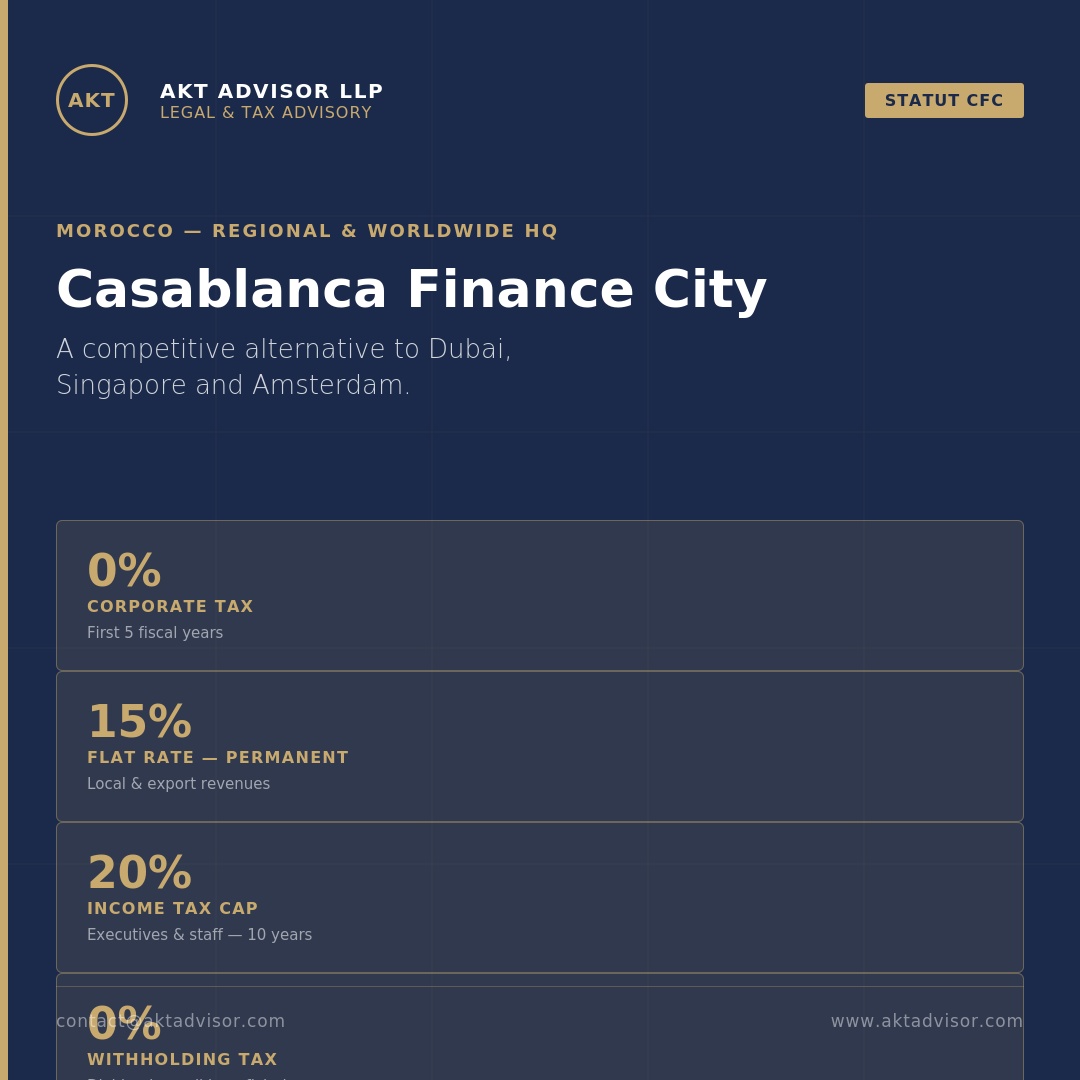
AKT ADVISOR LLP LEGAL NEWSLETTER | JUNE 2026 BUSINESS LAW STATUT CFC Casablanca Finance City: An Attractive Status for Africa-Focused...
A Comparative Analysis of Policy and Regional Friction (2025–2026) By Abdul BaghaManaging Partner, Innovus Risk and Advisory LLP | Founding...
Leave a Comment